
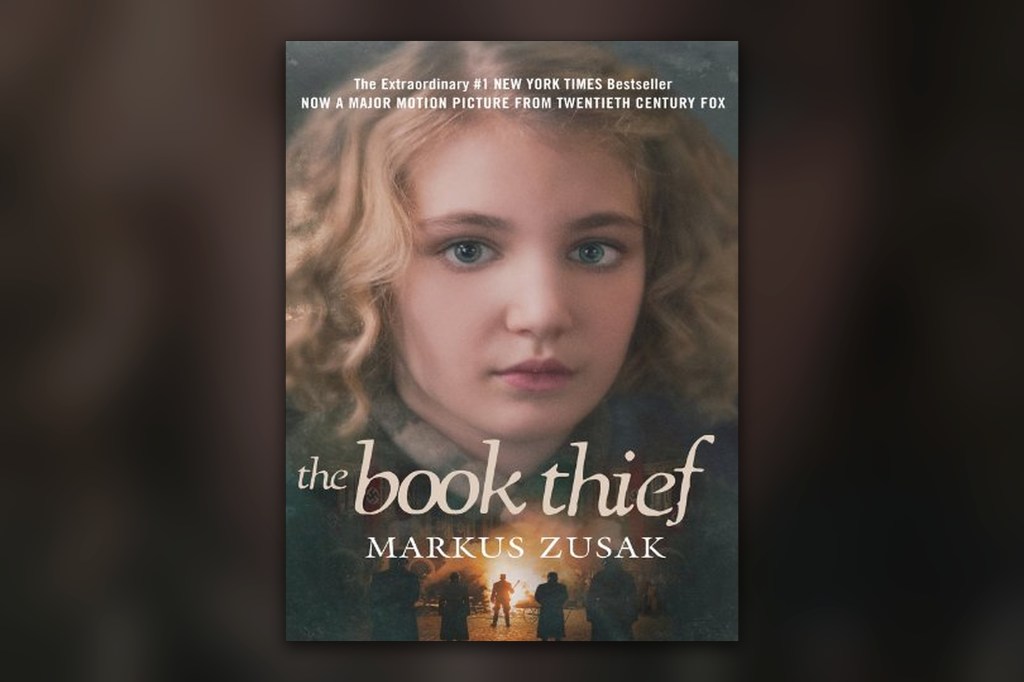
QUOTES
“A SMALL PIECE OF TRUTH I do not carry a sickle or scythe. I only wear a hooded black robe when it’s cold. And I don’t have those skull-like facial features you seem to enjoy pinning on me from a distance. You want to know what I truly look like? I’ll help you out. Find yourself a mirror while I continue.”
“She was the book thief without the words. … the words were on their way, and when they arrived, Liesel would hold them in her hands like the clouds, and she would wring them out like rain.”
“How about a kiss, Saumensch?”
ABOUT THE BOOK
It’s 1939 in Nazi Germany, and young Liesel Meminger is sent to live with foster parents on Himmel Street in the small town of Molching. Hans Hubermann is a gentle house painter who plays the accordion, and his wife Rosa has a sharp tongue to match her temper. Liesel arrives with almost nothing, except a book she can’t read yet. Over the next few years she learns to read, makes friends, and starts stealing books wherever she can find them, while the war closes in around her neighborhood. Telling all of this is an unusual narrator: Death himself, who is busy, a little weary, and oddly fascinated by this one girl.
LIKED
Here’s a young adult novel that doesn’t lean on vampires, love triangles, or first-world angst to keep you turning pages. It was published as adult fiction in Australia and as YA here in the States. Either way, the young adult section has plenty of books that could learn a thing or two from this one.
Then there’s the narrator. Death tells this story, and that choice stopped me in my tracks on the very first page. I’m sure it’s the first thing everyone mentions when they talk about this book, and for good reason. Death has a habit of letting you know what’s coming long before it arrives, and I’ve always believed that’s the mark of a confident writer: tell the reader exactly where the road ends, and still make them desperate to see how it gets there. Say what you want about Stephen King, but he’s a master of it. Zusak goes to that well a few too many times, but more often than not it lands.
I also appreciated whose story this is. These aren’t generals or party officials. They’re ordinary people on an ordinary street, nobodies in the eyes of history, whose lives are shaped by what happens to them far more than by anything they choose. It’s a welcome change from the familiar shorthand that every German of that era was simply evil, period, end of story. The truth was always messier than that, and this book lives in that mess.
Hans Hubermann, Liesel’s foster father, is the heart of the book. He’s a quiet, decent man who keeps doing the right thing even when it costs him, and the bond he builds with Liesel is one of the most touching father-daughter relationships I’ve come across in fiction. I was in his corner from the first chapter. His wife Rosa is the bigger surprise. She starts out as a loud, sharp-tongued caricature and slowly reveals herself to be far more than that. I didn’t see her coming, and that’s exactly what made her so interesting.
And of course, the main character loves books. How could I not fall for that? Underneath everything, this is a story about the power of words: how they can be used to poison a nation, and how they can also be the thing that saves you.
NOT SO MUCH
The story doesn’t always hang together. There’s a reason Death narrates, and I don’t have a problem with that choice, but his wandering style sometimes makes the book feel less like a novel and more like a collection of short stories that happen to share the same street.
The ending also felt rushed. The book takes its time for most of its length, and that slow, patient pace mostly worked for me. But in the final stretch, everything speeds up so suddenly that it felt like Zusak was racing a deadline and had to tie things off in a hurry. After all that careful build-up, I wanted the ending to have room to breathe.
RECOMMEND?
Absolutely. The Book Thief is a great pick for high schoolers, and it holds up just as well for adult readers. The prose could be a little crisper and the editing a little tighter, and some younger readers might get restless during the slow middle stretch. Those are small complaints next to what the book does well.
What stuck with me is how human it is. It takes one of the darkest chapters of the twentieth century and sees it through the eyes of a young girl who just wants to read, with Death himself as the reluctant, strangely tender witness. It’s sad, often funny, and it never feels like a history lesson. Out of the handful of World War II novels I’ve read, this is the one I expect to remember. If you’ve walked past it on the shelf because of the YA label, give it a chance. Just keep a box of tissues nearby for the last few chapters.




Leave a Reply