Introduction
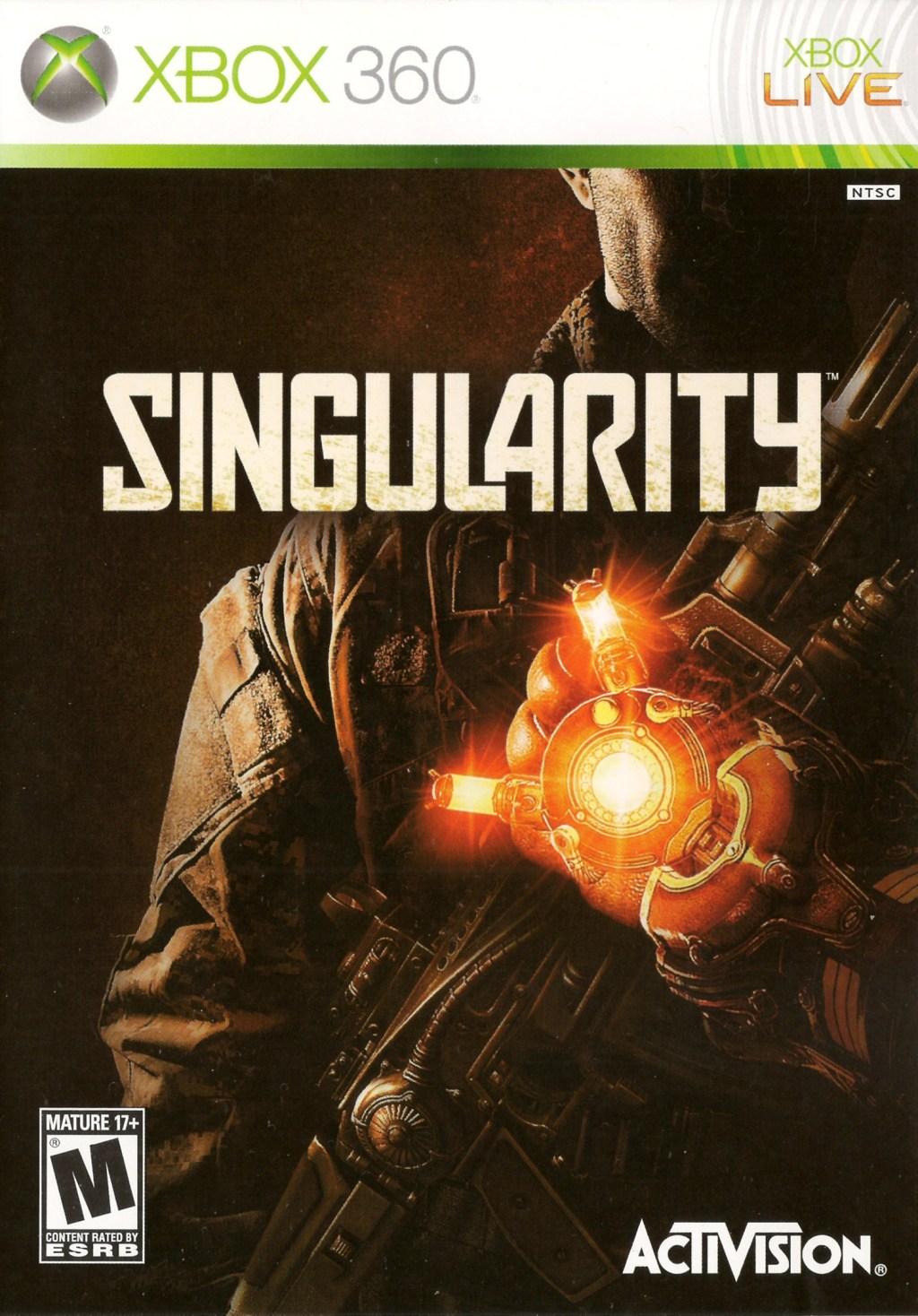
When you “borrow” heavily from two of the most popular and highly acclaimed games in recent history, you have to be prepared for the inevitable comparisons. If your game does not do the things those games did at least as well if not better, your audience can’t help but notice. So does Singularity hold up to the big boys it tries to emulate?
Story
Singularity is the story of black ops soldier Nate Renko, who’s transport crashes on an island research base called Katorga-12 while investigating radiation emissions. Turns out that Katorga-12 was the location of Soviet experiments with a newly discovered element called E-99, and the base and its research were covered up following an incident with a singularity machine which destroyed much of the island. When Renko wakes up on the island, he experiences some bizarre time shifts between present day 2010 and 1955 when the incident occurred. Something happens to alter the timeline, and back in an altered 2010 Renko is captured by soldiers under the leadership of Dr. Nikolai Demichev, who has used the E-99 technology to conquer the world. Renko is rescued by a resistance organization known as MIR-12, who base their hopes on a mysterious note discovered in the 1955 wreckage saying that a man from the future named Renko will be able to stop Demichev.
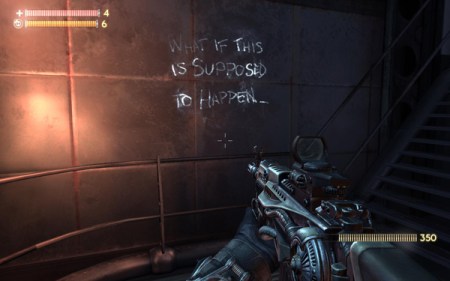
With the aide of MIR-12 operative Kathryn, Renko discovers the Time Manipulation Device (TMD) and uses it to travel back to 1955 and save TMD inventor Dr. Victor Barisov, who Demichev killed and stole the TMD from. With Barisov’s help, Renko must destroy the singularity machine prior to the incident with it in order to right the timelines.
Gameplay
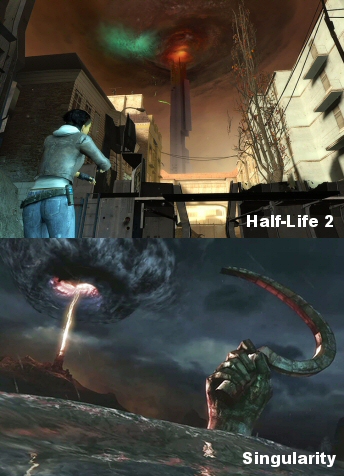
There’s no doubt that Raven Software was influenced heavily by both Half-Life 2 and Bioshock when developing Singularity. The game has the look and feel of Half-Life 2, right down to the slightly arcane feel you’d get by playing through Half-Life 2 these days. Singularity is a FPS with not a lot of frills, and with a rather generic burned out landscape. Add to it an experiment that went horribly wrong and transformed humans into monsters, a device that can you can use to pick up large objects and toss them about like a gravity gun, a building with energy spewing from the top, and a female ally that pops in and out of the story. and you have the makings of a Half-Life 2 inspired FPS. Singularity also uses audio logs scattered about as a narrative device, just like Bioshock. I know audio logs are not exclusive to Bioshock… Dead Space, Borderlands, Batman, Far Cry 2 and others have used them. Even Bioshock‘s “spiritual predecessor” System Shock 2 had a form of them. But add in the 1950’s vibe, one-way audio communication via radio and the TMD attached to your left arm like a plasmid power and you get that Bioshock feel. There are also nods to other games such as Fallout, with Dr E-99 subbing for Vault Boy.
The problem is that I don’t think Singularity did anything they borrowed from Bioshock or Half-Life 2 better than those games. The art deco 50’s architecture of Bioshock looked stunningly unique, while the 50’s of Singularity is bland and generic. Plasmids were more varied than E-99 powers. The enemy splicers in Rapture were far more interesting than the generic Russian soldiers or even the uninspired mutants in Singularity. Not to mention more conversational… I don’t know what those Russians are saying, but I think they only know three sentences in the whole game, and they shout them to anyone who will listen, whether they are the only one left alive or not! The audio logs in Singularity feel a little forced, with more than a few entries making me wonder why or even how someone recorded what they just said, especially on a huge reel recorder which apparently were plentiful. The Singularity version of the gravity gun might be the only improvement, with its ability to age or de-age things, but most of the time you use it you feel like you could be in Ravenholm instead.
The game has the feel of one that could have used more time in testing to refine the general gameplay. A glaring standout is boss fights. Sometimes you have ’em, sometimes you don’t. Sometimes your powers work against them, sometimes they don’t. In general terms, the cage fight and the train are memorable, but towards the end things just peter out. Though the game is entirely linear, the advantages of linearity are for the most part missed.
Speaking of linearity, one thing I hate in games is nonsensical barriers. There are many times in Singularity when the game wants to confine you to a certain area. Rather than doing that in a logical manner, say by a gate coming down, or having you jump down into an area you can’t climb out of, Singularity just blocks you off. You stride through an open door, and when you turn around it’s suddenly closed and doesn’t even register as a door anymore. This made for frustrating gameplay in many ways. There were instances where in the real world you would use a doorway to dodge in and out of as cover, but in Singularity you were instead left trapped and exposed in a dead end corridor with a wave of enemies attacking. Other times I left health packs or ammo behind because I couldn’t carry any more, but in the next room fought a big battle. I couldn’t back into the previous room to use the doorway as a choke point, and I couldn’t go back in mid-fight or afterwords to replenish my supplies with the ones I left behind. If the game gave you a reason why you couldn’t do these things, you would accept it and move on without a second thought, but when it doesn’t, then you feel cheated. Particularly when the game gives you a branching path, with one continuing on and one leading to a dead end with some goodies. If you choose the one that leads on, which happens often when it’s not obvious which to take, then frequently you can’t turn around and go back to see what you missed. By contrast, I can recall many instances in Bioshock when I’d wander back quite far to pick up some ammo or health pack I left behind. Balanced gameplay and more well thought out levels allow you to do that.
The game uses a checkpoint system that was frankly awful. I’ve seen worse, but I’ve played a lot better, and again it just felt like something that should have been caught during testing and quality assurance. Let me give you an example (minor plot spoilers… skip the rest of the paragraph if you want to avoid them). In Part 2 Research Facility you go through a time rift for the first time, to prevent Dr. Barisov from dying. There’s a checkpoint right after you come out of the rift, which makes sense. You then proceed through a rather difficult firefight (I had trouble in Hard mode at least), and finally you have an encounter with Barisov. Once that happens, the logical thing would be to have the next checkpoint after you the Barisov encounter but before you do anything else. There isn’t one, though, so when you attempt to leave the room and two more enemies attack you, if you die (and I did) you have to go all the way back to the time rift and do it all again. You finally get the checkpoint after those enemies, and then that causes issues with the next area. After the checkpoint you kill two easy targets and walk into Barisov’s lab. He goes through a lengthy in-game cutscene on how the TMD works and then tells you to use it on a safe. You do that and he gives you another in-game cutscene about the new weapon called the Seeker that’s inside the safe, which he then hands to you. That starts another wave of enemies converging on your position. Logically the game should give you a checkpoint after you are handed the Seeker, at the start of the battle. But it doesn’t give you one until after the battle, so that if you die in the battle (again, I did), you have to go through the non-skippable in-game cutscenes all over again. It just makes the game feel sloppy.
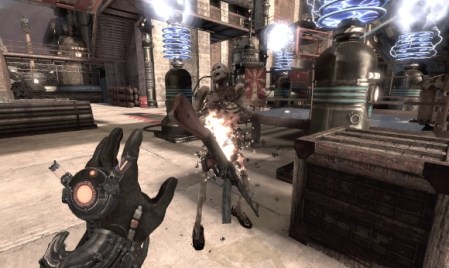
As I said, I played the game on Hard mode, so this next gripe might not apply to the other game modes, but it also felt to me like the enemy AI was incredibly accurate. Not just in shot accuracy, but in the seemingly uncanny ability to fire through corners and doors. I may not be a spry 20-year-old anymore, but the AI’s ability to move into a doorway and fire accurately at me without knowing beforehand where I’m at in the room is remarkable. I wish I had that kind of hand/eye coordination! Other times I died before I even saw the enemy come around the corner, which is why I said that they can fire through corners. Maybe not, but when you’re hit before you see them come around a corner, it sure feels like it.
Other complaints about Singularity may really be more nitpicks about design decisions than anything else. I hated how long it took to reload your weapons and to heal yourself. It was extremely difficult to do either in a fast action firefight. I know, you can “level” those up, but you won’t for a large chunk of the game. I also wasn’t crazy about the reload button (the blue X button on the Xbox controller) being the same as the button to interact with things in the environment. More than once I died during a firefight because I hit the reload button, only to read the note on the table in front of me instead, as I’m being shot at! Speaking of, I also died because of the pop-up boxes that explain to you what a new item or weapon is, because that game does that to you automatically and doesn’t stop the action! The game told me all about how cryo tanks can freeze enemies, while an enemy was pummeling me. All of these things taken by themselves are not big issues. But when you combine them all, it leads to some rather frustrating gameplay. That is,until you get Deadlock.
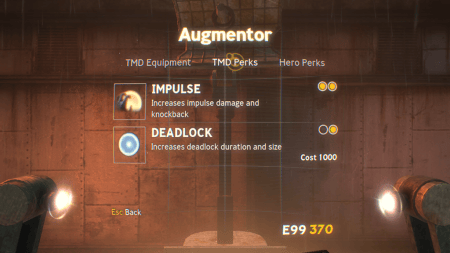
The shining light of Singularity is the Time Manipulation Device’s “Deadlock” feature. With it you create a time bubble around whatever you shoot it at. Inside, time slows down for everyone but you, so you can run circles around enemies inside it, shooting them in creative ways and then watching the body parts fly when the bubble disappears. The effect can be very fun at times. You don’t get it until you’re a third of the way through the game, though, and it makes the gameplay unbalanced. Most of my complaints about the weak game mechanics above disappear once you get Deadlock. The ability to freeze the action in place pretty much eliminates the aggravatingly accurate AI gunplay and annoying reload times. Even checkpoint placement, while still occasionally problematic, becomes less annoying because you just don’t die as often. It’s almost as if you have two separate games, one that’s a standard FPS covering Chapters 1-2, and another with Deadlock covering Chapters 3-6. It’s too bad that Raven didn’t just give that to you at the beginning, and balanced the gameplay more around it across the entire game.
Extras
I didn’t play any of the game’s multiplayer, which I’ve read is a different experience from the single player and hasn’t gotten rave reviews, so I can’t speak to that. The game does not let you replay various parts once you’ve finished the game, which seems odd and again very rushed. So there’s not much replay value unless you want to go through the whole thing all over again. There are multiple possible outcomes in the game, and you can reload the game after the credits roll and get multiple achievements without fill play throughs. There are also a few esoteric achievements, like one that’s a reference to the Lost television series, that many people may miss.
Conclusion
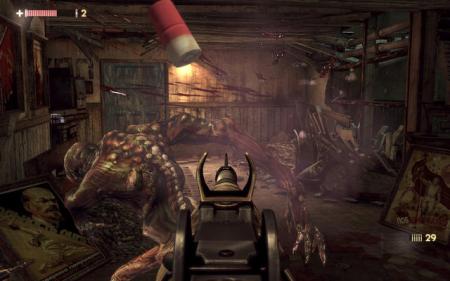
For the record, I played through Singularity once on Hard Mode and got 21 of 50 achievements for 480 of 1000 gamerscore. Singularity was not on my radar at all. I became interested in it primarily though podcasts and gaming websites, who gave it some surprisingly good reviews. Destructoid called it “quite possibly the best new FPS this year so far.” Gamespot called it “incredibly fun” and Game Informer said that the single player game “should not be missed.” A good sale on Amazon and the offer of a free disc copy of Prototype (a game I nearly bought several times), combined with loose comparisons of two of my favorite games in recent years, led me to pull the trigger and buy Singularity. Overall I’m not sorry I did, but I’m not sure I’d do it again. I think some reviewers would like Singularity to be the game that has little pre-publicity but turns out to be spectacular, but it just doesn’t live up to the post-release hype.
The plot of Singularity is marginal at best and over-convoluted at worst. The game did have some interesting gameplay mechanics, most notably the Deadlock feature of the TMD, but the balance was off and the latter third of the game kind of fizzled out. Overall it’s a solid but uninspired FPS with a few wonky design decisions. The devil is in the details, though, and that’s what let me down. Details are what made the games like Bioshock and Half-Life 2 great, and made Singularity just mediocre.
Wanna see my thoughts on other games?
Check out my other Game Impressions.






Leave a Reply