Introduction
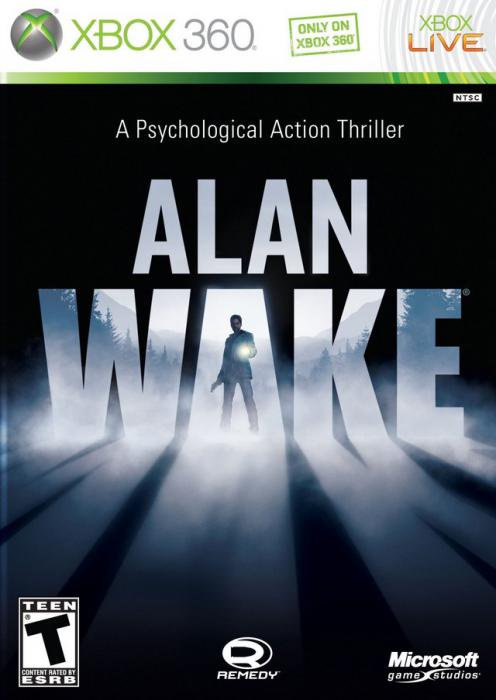
It’s no surprise that I would gravitate towards a game whose first spoken words are “Stephen King.” But that doesn’t mean I will automatically like it. Alan Wake is a psychological thriller action adventure game developed by Remedy Entertainment (aka the folks behind the Max Payne series) and published by Microsoft Game Studios. It follows the story of thriller novelist Alan Wake, whose vacation trip to Bright Falls in the Pacific Northwest is cut short by the disappearance of his wife and the strange, supernatural events surrounding it. So was the story a sleeper, or did I have no trouble staying A. Wake?
Story
Thriller writer Alan Wake and his wife Alice rent a cabin on an island on a lake in Bright Falls, a rural town in the Pacific Northwest. What was intended as an idyllic respite that will hopefully recharge the batteries of the struggling novelist turns into a nightmare when Alan’s wife appears to have fallen into the lake and disappeared. Alan wakes up behind the wheel of a crashed car a week later, knowing that something happened to his wife but having no memory of what happened over the past week.
To make matters worse, Alan starts finding loose pages of a manuscript to a novel that he has no knowledge of writing, which seem to foreshadow events that are happening around him. Dark forces seem to emerge from thin air to threaten him that are repelled by light. What does this Dark Presence want, and can the writer do to save his wife Alice?
Gameplay
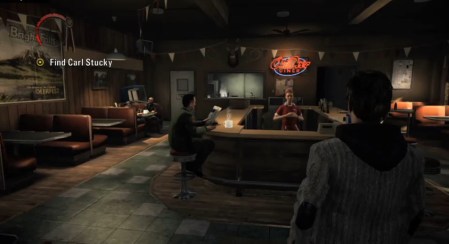
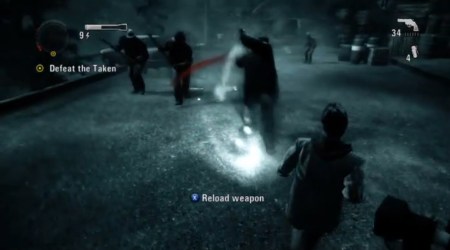
Alan Wake is primarily a 3rd person over-the-shoulder action game set in a variety of locales, and in daylight and nighttime settings. Daytime action is mainly travel, exploration and puzzle-solving, and the spooks come out at night. These figures have a dark aura around them that needs to be burnt off with light (flashlight, work light, overhead lamp, flare, flashbang) before they can be harmed (revolver, shotgun, rifle). There’s not much more to the action that that, but it’s surprisingly effective in that whether enemies are rambling towards you or charging at you, you can’t harm them until you burn off their aura, making for some challenging action sequences. There’s a dodge move that you’ll learn to perfect (Remedy fans will liken it to the Max Payne bullet time effect), and there are sequences where inanimate objects fling themselves at you, which can be destroyed by the same aura-burning effect. I had very little issue with the controls, and though over the course of the entire game they got a little repetitive, they felt very smooth and natural.
The plot is presented over six episodes, and the episodic nature of the story built right into the game. Each episode ends with a cliffhanger cutting to a black screen that announces “End of Episode 1” and so one, and a full song plays that usually relates to what just happened. The Roy Orbison licensed song at the end of Episode 1 and the Poets of the Fall original song at the end of Episode 4 are definitely standouts, and some of the best use of music in a video game that I’ve seen. Then the next episode starts with a “Previously on Alan Wake…” narrative with cutscenes that recap they story so far. It’s pretty unique from my gaming experience, and it will dovetail perfectly with the episodic downloadable content.
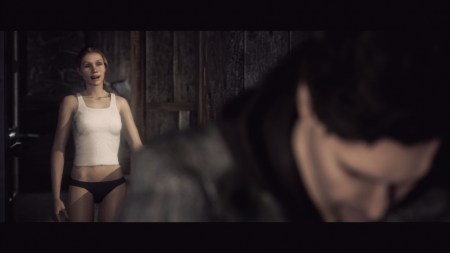
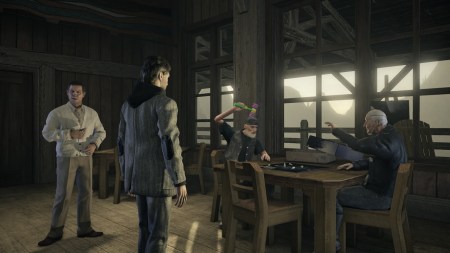
One of the highlights of the game for me was the story itself, which is difficult to discuss in any detail without giving away spoilers. And the detail is where the story really shines. As of this writeup, I am two-thirds of the way through my second playthrough of the game, and as impressed as I was during my first trip through the story, I’m amazed in the second trip at how much detail there is in each and every scene. The ferry and diner scenes in the first episode, for instance, have between them nearly all the major characters in the game in it, though you don’t realize it at all the first time you play though it. There are little hints everywhere of things to come, from posters on walls to things people say.
The plot of Alan Wake is definitely one that makes you sit back and think about. It’s not confusing per se, but it wraps around itself, and new discoveries make you relive in you mind past events, and try to figure out whether everything fits into place. There are a few unexplained red herrings (driver’s license), but in general the game gives you just enough to feel like you’ve gotten some answers, while leaving other things open for interpretation and/or future events.
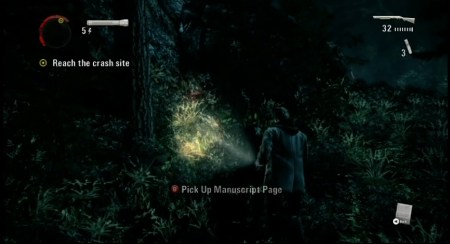
Overall I found the game very engaging, and it made me want to keep playing to find out what was going on. It’s a Twin Peaks meets Lost type of game, except that you do get some answers. Cultural references abound. In addition to Lost (dark presence, light and shadow) and Twin Peaks (log lady, “Oh Deer, Diner” with jukebox, Mirror’s Peak, coffee), there is Stephen King (Cauldron Lake Lodge, hedge maze, axe thru door), Alfred Hitchcock (birds), Poltergeist (“They’re heeeeeere!” achievement), The Twilight Zone (“Night Springs” show), and so on. Many references are funny moments, but there are other funny bits as well. While some found him too annoying, I liked Barry Wheeler carrying around the standee like it’s some time of talisman that wards off evil. And the names off some of the achievements are pretty clever.
There were a couple of things I wasn’t crazy about in Alan Wake. Too many forests is probably at the top of the list. The gameplay works best when you are walking through a dark, creepy forest, but occasionally it seems like Remedy went out of its way to come up with ways to dump you right back into that setting. There are a variety of other locales which do offer a nice break from the forest action, and I’d have preferred a little less forest and a little more of other locales. I’d also have preferred that the game had more smaller episodes rather than six large ones. I’m the type of player that likes to sit down at a game like Alan Wake and play through one episode in a sitting. But it usually took me about 4 hours to thoroughly play through an episode, and since I usually can’t start playing until 8:30-9pm, that made for some late nights. Finally, the collection side quests, which I’ll detail more in Extras below, sometimes took me out of the gameplay. When you are going somewhere with another character, and time is off the essence, it’s a little odd that they stop and wait for you, usually without comment, and you read every little sign or wander off in the opposite direction looking for a thermos. That seems to be an issue with a lot of games lately, and Alan Wake has it as well, even though Remedy does attempt to incorporate some of that into the narrative.
Extras
You can usually tell a “game journalist” from an average joe by whether or not they bring up that it took 5 years to make Alan Wake. I personally rarely pay attention to who makes what, and how long a game takes really has no bearing on a review of it. But if the length of development time translated into the plethora of extra material surrounding the game, then it was well worth it to me, because there is a lot to be had.
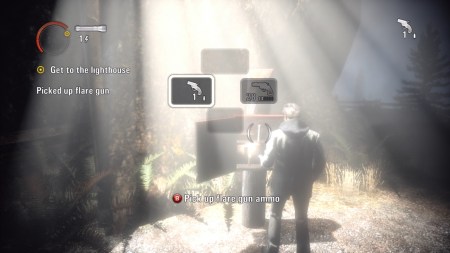
First of all, in game, there are numerous “collection quest” things to do and get, as I mentioned before. Many of these are tied to the story, and some are more successful at doing that than others. Things like finding all the weapons caches or all the manuscript pages, or listening to the radios, dovetail perfectly with the narrative. Other things add to the ambiance, like the “Night Springs” episodes. But some fell a bit flat, like finding coffee thermoses (did Rose leave them for you?), reading all the informational signs, or knocking over all the pyramid cans, all of which felt more like just things to do.
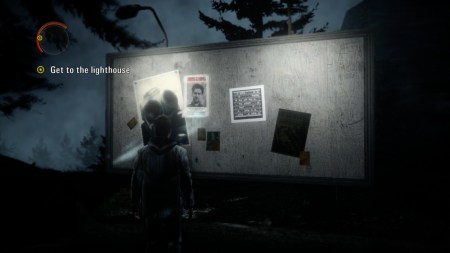
There are several easter eggs that I’m sure you can find details about in a multitude of places, but one thing that may go unnoticed in your playthough is the use of Microsoft Tags. I admit that I didn’t even how what Microsoft Tags were, though on further investigation I realized that I had seen them before and just didn’t know what the deal was. Microsoft Tags are white squares with patterns in them that work like bar codes, except that when they are photographed with a Microsoft Tag Reader on your cell phone they will produce a variety of effects. There is one near the beginning of Episode 1 on a sign board that will take your phone to a website with a code to download a free Alan Wake / Verizon Wireless Xbox theme. Another is in Alan Wake’s apartment, and makes your phone dial Alan Wake’s supposed number and lets you listen to his voicemail. The last is in Cauldron Lake Lodge, and makes your phone call Dr. Hartman’s supposed number and lets you listen to his recorded message. After numerous tries at taking the picture and getting the tag reader to recognize the tag, I finally succeeded on the theme one. On the other ones, when I got the reader to accept the tag, my Blackberry would try and fail to dial the numbers, so I listened to them online instead. (Note also that I’ve seen it written elsewhere that these may only work in the U.S.)
There are at least two additional episodes that extend the original story of Alan Wake that are or will be available as DLC. The first one entitled “The Signal” releases today (July 27th) and is free to all Limited Collector’s Edition folks, and the second called “The Writer” will be coming at a later date. They will have additional achievement points associated with them.
Speaking of the Collector’s Edition, which I bought, it comes in a nifty box that looks like a novel, and has several good things in it. It includes a code to get “The Signal” DLC for free. It also has exclusive in-game commentary, which I turned on for my play through Nightmare difficulty. It occasionally pops up a picture-in-picture style video of the developers talking about the current scene. Also included in the CE is a soundtrack CD, a theme and avatar, documentaries, and probably the best item, a book called The Alan Wake Files by a fictional man named Clay Steward, whom you meet in the game. Anyone interested in some of the intricacies of the plot details will love this book. I also picked up The Official Survival Bundle strategy guide and artbook. I didn’t use the guide much on my first playthrough, but I’ve used it pretty extensively on my second go, and found it to be extremely detailed and well written. The hardcover artbook, called Alan Wake Illuminated, is very nicely done too. I gleened extra tidbits of plot and story from all of them.
There are two other tie-ins that I know of for sure. One is an official novelization of the game, appropriately entitled Alan Wake by Rick Burroughs that I’ve been reading on my Kindle. If you don’t want spoilers, I’d recommend playing the game first. It is interesting to see things fleshed out a little more, though there are some differences here and there. As an adaptation, it’s not exactly canon, but it’s a good read nonetheless. There is also a six-part live action prequel mini-series available for free on Xbox Live entitled “Bright Falls” that I watched before playing the game, and may revisit post-game. It was decent enough, and interesting to see live action counterparts to the in-game characters.
Conclusion
I played Alan Wake all the way through on normal difficulty, which unlocked Nightmare difficulty. As of this writing, I’m two-thirds of the way through the game on Nightmare difficulty. I’m currently have 38 of 58 achievements for 610 of 1000 gamerscore. I haven’t played any DLC yet, though I’ll be downloading “The Signal” in a few minutes once this is posted.
Alan Wake has all the trappings of a great mystery thriller. It does a superb job at stringing you along, extending the mystery without making you frustrated by the lack of any answers. My nitpicks about the multiple forest scenes and the repetitive gun and light gameplay mechanic only detract slightly from the game, but don’t dampen my enthusiasm. From the atmosphere to the lighting to the music to the bonus content, Remedy Entertainment has done a superb job at bringing the fictional world of Alan Wake to life, both in and out of the game. It’s a heavyweight contender for my 2010 Game of the Year. It’s a summer light in a sea of mediocre summer gaming darkness (or is it an ocean?), and a game I highly recommend.
Wanna see my thoughts on other games?
Check out my other Game Impressions.






Leave a Reply