Introduction
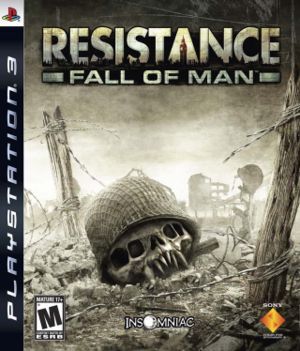
My game impressions segment returns after much neglect, with an older title I recently picked up and finished. Resistance: Fall of Man was released for the PS3 on November 14, 2006 as a launch title for the PS3. I didn’t get a PS3 until a year later, and when I did, I downloaded the Resistance demo and played it a little, but I couldn’t get into it and deleted the demo before I ever finished it. I thought maybe I’d look for it cheap someday, but it wasn’t on my “must play” list. Fast forward to E3 2008, and Resistance 2 was all the talk of Sony’s press conference (not to mention Resistance: Retribution coming for PSP). With news of the upcoming releases, I figured that maybe I would download the demo of the original again and give it another try.
I did much better on my second try at the demo, and thought it was rather enjoyable. As timing would have it, Resistance: Fall of Man was named to the PS3 Greatest Hits title at E3 2008 as well, meaning a price drop from $59.99 to $29.99. With some Best Buy Reward Zone coupons burning a hole in my wallet, I picked it up for $19.99 on Friday and started playing. By Sunday afternoon, I completed the game on Normal mode.
Story
An alternative Earth time line is the backdrop for Resistance: Fall of Man. The end of World War 1 lead to peace and prosperity, with an allied Europe sans Nazi’s and World War 2, and an isolationist czar-ruled Russia. Coinciding with the Tunguska event in 1908, something started happening in Russia. The Russian Empire built a wall against it’s European border in 1921 called the “Red Curtain” and began a communications blackout. Rumors spread around the world of destruction in Russia, but nothing is confirmed until 1949, when the Red Curtain is breached by forces known as Chimera, who overrun continental Europe in 1950 and dig under the English Channel to attack England in late 1950. Most of the population is wiped out, save some who fled to scattered bases in northern England.
The game picks up 1951 with Sgt. Nathan Hale, part of a force of United States Army Rangers sent to help Britain and retrieve a secret weapon. The U.S. forces arrive at York, and are quickly attacked by the Chimera by a “spire” which releases bugs that swarm over the soldiers and infect them. Sgt. Hale is infected as well, but seems somehow resistant to the infection, which has given him some limited powers. After York, Hale ends up at a Chimeran conversion center in Grimsby, where humans are being taken to be converted into Chimera. He rescues a female Captain named Rachel Parker, who is the narrator for the game as well as one who talks to him via radio.
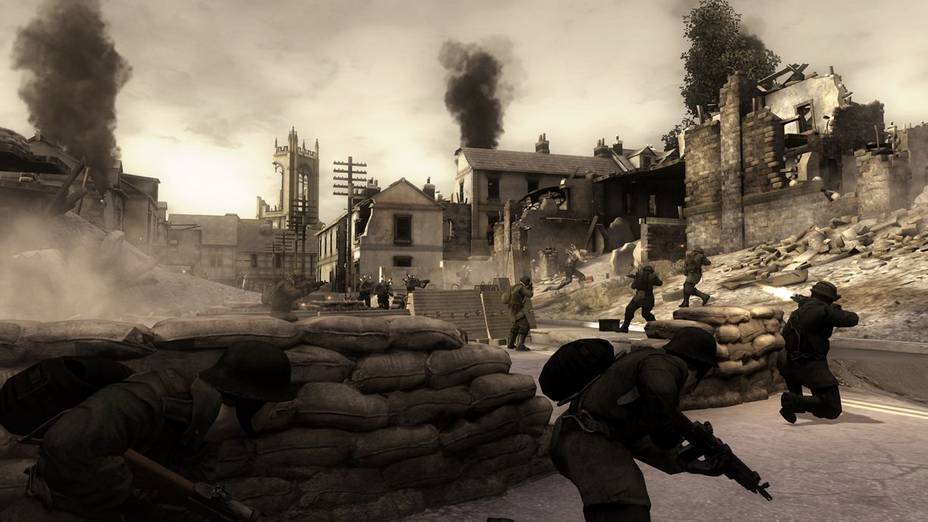
Hale gets picked up, fights through various scenarios, such as in the Manchester Cathedral (more on that later) and Hale delivers the secret weapon, a Chimera known as an “Angel” to the northern command base, only to be attacked. Hale meets up with a British Royal Marines commando, Lieutenant Cartwright, and through several chapters discover a series of metallic towers around England, that were once buried and now uncovered, not constructed. The towers are connected by power conduits. Hale follows the conduits and figures out that the main tower is in London.
The Americans launch an assault on London, blowing up the Tower bridge and so forth. Hale makes his way to the top of the main tower and destroys the reactor. This blows up the tower and causes a chain reaction that blows up the other towers around England. Hale is thought to have died in the explosion, but is instead picked up by helicopter by a mysterious black-ops group in the last scene.
Gameplay
The game plays out as a pretty typical first person shooter. In fact, it is so typical that much of it seems derivative and unoriginal. Run, avoid, shoot. There is no cover system (ala Gears of War). You can jump and squat, but that’s about it. There are multiple weapons that you acquire throughout the course of the game, which prove to be one of the only original aspects of gameplay.
You can use both human and Chimeran weapons. I used mainly the M5A2 Carbine and the Bullseye thoughout the game. The carabine is a standard gun wit grenade launcher. The Bullseye, one of the most effective weapons, shoots energy bolts, and has a tag system whereby you can tag an enemy and your shots will follow them even if you aren’t aimed directly at them. The Hailstorm fires bullets reminicent of a nail gun that bounce off walls. The Auger fires energy bolts through solid objects, which makes it good for hitting enemies behind cover. The Sapper drops bio-mines, which are useful in stopping dumb and swarming creatures. Other weapons include the standard shotgun, sniper rifle, and rocket launcher.
Hale’s abilities are boosted somewhat by being infected by the Chimera, but this only amounts to partial health regeneration and the ability to heal through Chimeran sym-packs. Nothing controllable, or akin to a Bioshock-like experience. Although I’m sure that more will be revealed about this in subsequent games, it seems almost a waste to infect Hale right at the beginning of the game, for what little they did with it.
The game introduces a skill point system, which seems to be Insomniac Games version the Xbox 360’s achievement system. Various skill points get unlocked for doing different things, like killing 5 enemies with 1 grenade, or whatever. As you accumulate skill points, you unlock things like artwork and skins, which I guess is alright but really doesn’t add much. I think the appeal of Achievement Points on the 360 is that they can be seen by other people. The PS3 didn’t have achievem… err, I mean trophies, when Resistance was released, and Insomniac Games said it has no intention of implementing them retroactively in Resistance: Fall of Man, so the whole skill point system is an interesting but rather useless addition.
The color palette is gray, gray, gray. And brown. Just like other recent games like this (I’m looking at you, Gears of War). I’m tired of gray-brown palettes.
The story unfolds not only through the narrator, but through intelligence packets you find along the way. May of them refer to a group called the Cloven, which appear to be like the Chimera but hostile to both them and the human forces. It’s strange and a bit confusing that they are mentioned in the story but play no part in it whatsoever. I don’t know if they were taken out, or will play a part in the upcoming sequels, or what, but I found it a little distracting that they were mentioned so much but never encountered.
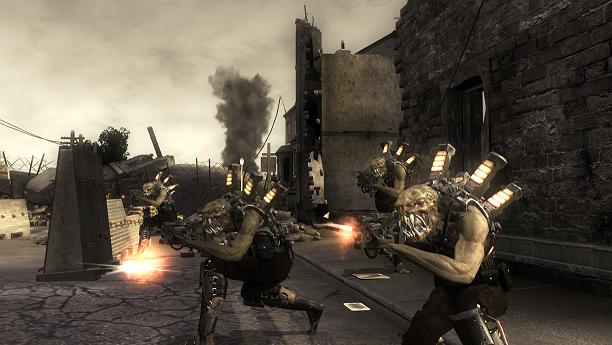
The chapters are varied, with a good amount of different locales, each set up by the narrator. Unfortunately, while the style is varied, the gameplay is entirely too linear. Don’t get me wrong, I wasn’t expecting a sandbox game here. But the levels were ridiculously linear. A game like Bioshock had area levels, but you were pretty much free to explore and go through them any way you wanted. Resistance leaves you with one way to go, and no other. For instance, when you get to London, you start in what looks like a shopping mall, with two sides and an open area in the middle. Your path through this, up one side, down, over to the other side, and out, is entirely pre-determined by convenient rubble piles and collapsed walls and overturned carts. Much of the game is like that. Seems a little old skool for next gen.
Convenient gameplay mechanics also frustrate at times. For instance, several times during the game you have to square off against spider-like machines called Stalkers. They have a weak spot on the back that you have to shoot to do any damage to them. It makes for a fun battle, trying to get behind them to fire at them, while avoiding the front-fired gun. Towards the end of the game you get to get in and control one, which is also fun. However, after fighting an even bigger machine called a Goliath, and then several Stalkers, mine was pretty damaged. And some Chimeran troops shot at it and I blew up. And not from behind at the weak spot. From the front! How come when I fire at them, using the same weapons, I have to hit the spot on the back to do any damage??
Another classic game ploy is the final battle. You are in a rather circular room, with the central fission reactor in the middle. There are for power rods, protected by panels, which you have to destroy. You click one button to drop all the protective panels, which of course drop one by one. I took down the first rod with about 6 shots. The last one, when the battle in the room reaches its peak, took something like 40 shots! For the same type of rod, for no apparent reason.
The game employs a classic checkpoint system for saves, which is perfectly common but not one I enjoy very much. Several times I felt as though the checkpoints were misplaced, and I replayed several chapters, like “Burning Bridges” over and over until I figured out the pattern. I’d rather just save as I go, but checkpoint systems are not unusual in gaming.
Controversy
I had forgotten until I got to that point in the game that there was a controversy involving the use of the Manchester Cathedral in one chapter. You start the chapter there, where your allies try to regroup, and fight some enemies in the trashed building, before making your way outside. The Church of England was in an uproar about this, threatening legal action for using the cathedral backdrop without permission and desecrating it. They said fighting in the building was sick and sacrilegious, and demanded that Sony pull Resistance: Fall of Man from the shelves, apologize to the Church of England, and make a “substantial donation.” They also criticized Sony for using Manchester at all in the game, as the city apparently has a gun crime problem that they felt was exacerbated by a shooter game set there.
Sony took the position that the game is a science fiction game set in an alternate 1950’s universe where you are holding off an alien invasion. The use of a likeness of the building was no different than Godzilla and the Tokyo Tower or King Kong and the Empire State Building. After about a week, Sony issued a reserved apology, and several weeks later published an unreserved apology in the Manchester Evening News. They did not, however, pull the game from shelves or give the Church of England any donations.
My feeling is that is was much ado about nothing. The BBC News sensationalized it with articles titled things like “Sony ‘sorry’ over cathedral game.” Resistance: Fall of Man is by no means a “cathedral game.” In fact, I’d be surprised if the entire amount of time spent in the building is 10 minutes. Most of it is empty, with some overturned and in-place pews. I can’t recall an altar or really any religious symbols shown. To me, it was reminiscent of classic bombed out church photos in World War 2. And in fact, the Manchester Cathedral was the second most damaged cathedral in England in World War 2. An area very near the cathedral called the Manchester Cathedral Steps was used as an air raid shelter. The things that people get worked up about these days never fails to surprise me. Next thing you know, someone will get upset about the images of a destroyed Washington D.C. for the upcoming Fallout 3 game. Oops, nevermind.
Extras
The game contains a single player campaign, and offline co-op campaign (why offline??), and online and offline multiplayer modes. Completing the game unlocks 5 new weapons. Getting various amounts of skill points unlocks skins and soldier medals. Beating the game on hard unlocks Superhuman difficulty. None of which would inspire me to play the game more than once.
Conclusion
Resistance: Fall of Man is a decent game overall. I think some review sites tried to make it the PS3’s killer game, giving is scores in the 90s (IGN 91, Game Informer 9.5), but the Metacritic score of 86% is probably not far off the mark. It was just a little too unoriginal to be much higher. At times it felt like Half-Life 2 Meets Call of Duty. Once you start looking for things the game reminds you of, the less distinct it becomes.
The gray-brown palette I like to rant about didn’t increase my opinion of the game, and the derivative gameplay like the too-linear paths didn’t set it apart as a next gen game. Neither did the graphics, which were solid but underwhelming. The gameplay video of Resistance 2 shown last month look a lot better, leaving me to wonder how much better this game could have looked. Maybe the fact that it was a launch title means it just wasn’t as polished as it could have been.
Overall I’d say it was a decent first person shooter. If you are interested in picking up Resistance 2 or Resistance: Retribution and want to see where it all started, by all means pick up this budget release. I enjoyed the 12-13 hours of single player campaign. I hear that it has a decent multiplayer as well, with extra downloadable maps available, but I don’t know it that’s still going strong almost 2 years out, as it’s not really my thing. I’m glad I waited and saved money on it, but I’m glad I played it.




Leave a Reply